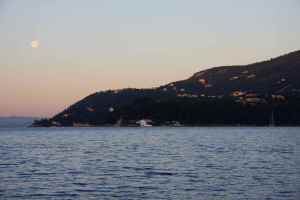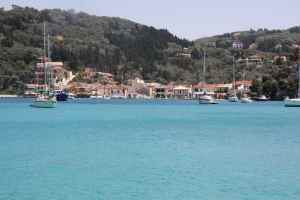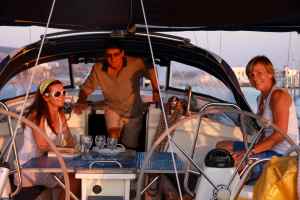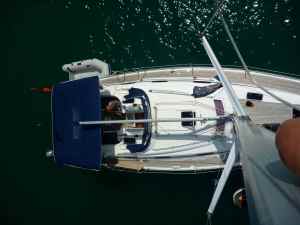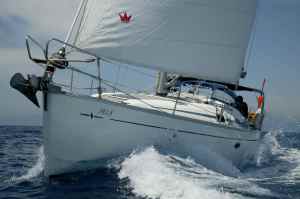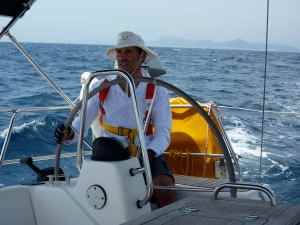
Blog 4: The Gulfs of Patras and Corinth – unexpected surprises

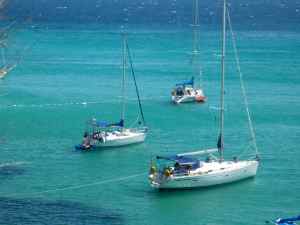
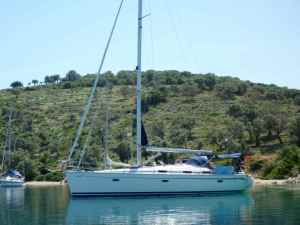
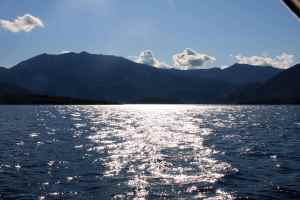
We had perceived the Gulfs of Patras and Corinth as waters to be crossed only to necessiate moving between the wonderful sailing areas of the Ionian and Aegean Seas. Both bodies of water have a terrible reputation for strong winds and currents, which of course usually run against you. We were very pleasantly surprised, by the lovely anchorages within easy access of interesting land content. We lucked out both ways, with very favourable winds and settled weather, which made the trip even more enjoyable.

1

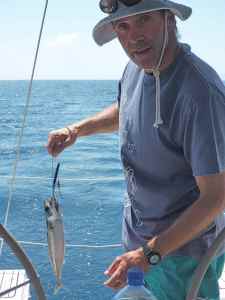
We even managed to catch a fish (within 2 hrs of trying out our newly constructed rig – but haven’t caught another since!)
2

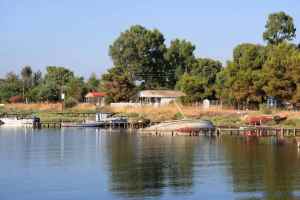
We then berthed for the night at Missalonghi, (Sussex Inlet Greek style). Note the eucalyptus trees – makes us homesick!
3

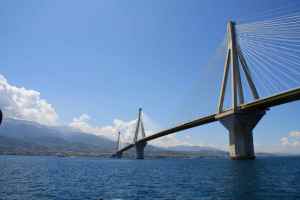
We had an early start into the Gulf of Patras and passed under the huge Rion Bridge at the narrow junction between the Gulf of Patras to the East and into the Gulf of Corinth with the winds and current (2kts) behind us. 
4

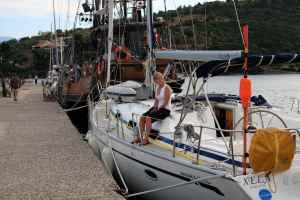
The afternoon was very relaxing, we enjoyed a good sail with brisk winds, having assumed that the winds would drop as we entered the ‘marina’ at Trizonia. To our dismay, the winds persisted, gusting to 18knots inside the very small harbour. As there were few free spots in the harbour. We then spent a very stressful few minutes anticipating trying to work out how to “shoe-horn” Xela into a tiny spot along the concrete breakwater, in shallow water, behind a huge Canadian flagged “pirate” ship with the strong cross wind on our beam. We could imagine the sound of plastic boat grinding/crunching against concrete as we pulled in side on with the wind amid a scramble of lines. Amazingly, all went well, with Ian skilfully settling Xela without incident.
5

6

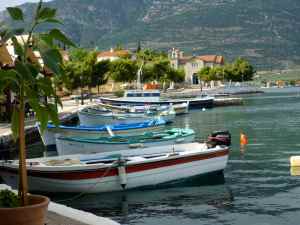
 We needed a day ‘recovering’ in lovely Trizonia, drinking coffee, planning our travels and communicating with friends and family.
7

8

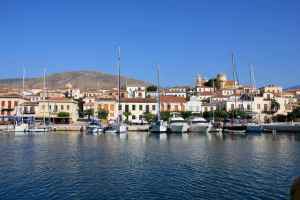
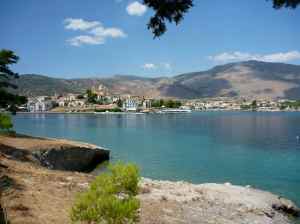
We spent quite a few days on the town wall in Galaxidi (our jewel of the Gulfs), a small, pretty, friendly and non-touristy town, with some lovely cafes and restaurants – and by far one of the best stop-overs in the Gulfs.
9a

9b

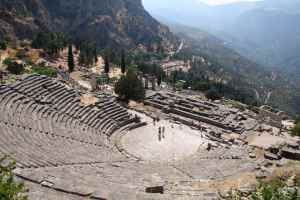
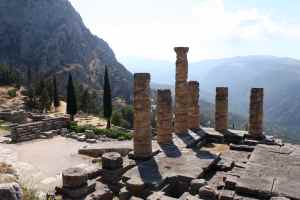
It is a great base to visit the wonderful site of Delphi nearby, a rather hairy hour long bus ride away. The ruins are fantastic and are in a really spectacular site high in the hills. The newish museum is also great. 
10

11

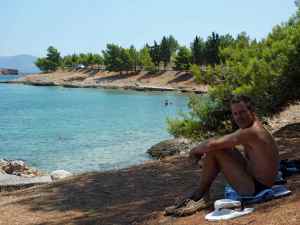
Galaxidi has some lovely swimming spots, so we took some time out to sit, read and relax, something (surprisingly) we don’t manage to do enough of! Life on a yacht is much busier than we had expected, with days passing so quickly with seemingly little achieved!
12

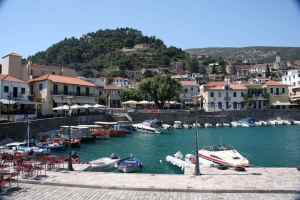
Navpaktos, also a short bus trip from Galaxidi, is another “must see” of the Corinth Gulf. It  is a small walled harbour close to the Rion Bridge. As the harbour only holds about 3 yachts, travel by bus seemed a good option also enabled us to see the beautiful countryside and towns along the Gulf. 

13

14

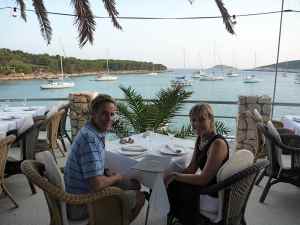
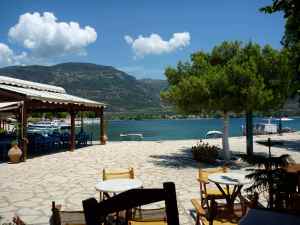
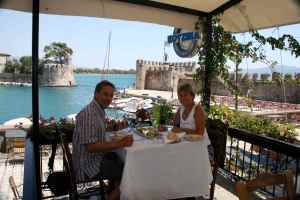
Had a very pleasant lunch overlooking the harbour. What is unbelievable is that it is now peak season and no-one is around. Locals say that tourism in the Gulf is down by about 50% this year. The number of empty tables (behind us in the photo), and lack of difficulty getting into anchorages certainly indicate that this may be true. 
15

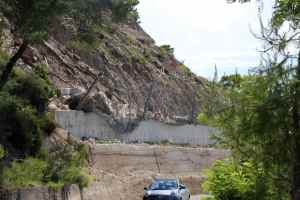
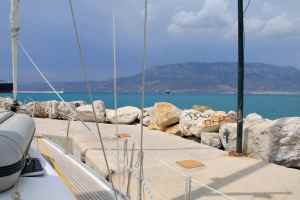
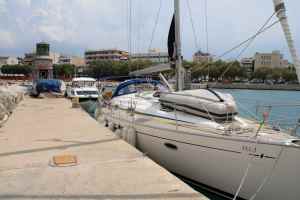
As we wanted to get an early start down the Corinth Canal before our long sail into Athens, we spent the night at the Corinth Harbour. Must admit, we reached a bit of a low point here as we arrived with a screaming wind behind us, to be directed into a tiny spot alongside a concrete wall – with a bend in the middle which added to the fun of berthing. A rather traumatic (but successful) berthing achieved, we settled into our berth overlooking concrete adorned with graffiti, views of the rather dowdy port behind and warnings from Port Police to lock the boat as, unlike other parts of Greece, crime is big problem in Corinth.
17

18

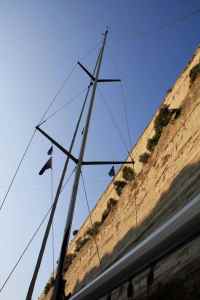
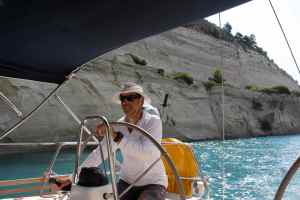
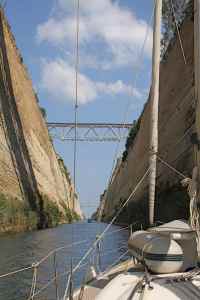
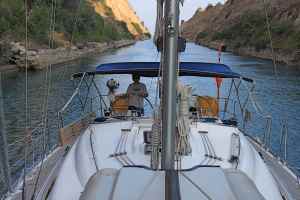
The Corinth Canal was spectacular. It is was built in the 1880’s, is 2.8 miles long, only about 25 metres wide and 7 metres deep. It is supposed to be one of the most expensive waterways in the world, costing 180 Euros each way for Xela. We were lucky to pass through the canal in calm weather, with only one yacht ahead of us. Some other yachties we met were following a tanker through when it stopped suddenly. As they were trying to control their yacht, they saw the cause, a bungy jumper coming down from the bridge above and almost hitting their mast! 
19


20

21

22

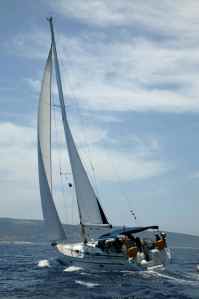
Off to Athens, the Cyclades and the Saronic Islands!
Blog 3: The Ionian adventure

8E8W1894
The passage.
Early June: We set off for the long anticipated passage from Bar (Montenegro) to Corfu – bypassing Albania – a 170Nm sail which we estimated would take about 25-30 hours. After waiting in Bar for several days for the strong southerlies to settle down, we at last headed off into a “moderate” southeasterly, which crept up to 22knots. After 8 hours of beating into the wind, rain and nasty, increasing seas, the 1pm weather forecast predicted a south easterly gale. So, with 38Nm under our belt, we had 3 choices: a) push on as far as we could and if it became untenable, seek refuge in Durres on the Albanian coast. This would entail a difficult piece of pilotage on a shallow coast and lee shore – in the dark. b) try and go all the way to Corfu in a gale (? 35-40hrs), or c) Turn back, return to Bar and wait for better conditions. We chose the latter. A very frustrating day; 81Nm sailed in messy sea to arrive back where we started after 13 hrs.

P1000508

Back in Bar ‘marina’ (not the most salubrious!) we spent the next few days itching to get away; checking weather reports daily and at the local internet café, planning our future travels and sightseeing around Bar.

Passage planning - ?via Brindisi or straight to Corfu

Passage planning - ?via Brindisi or straight to Corfu

 Set off again for Greece four days later; a much different story! No wind warnings, decreasing seas and pleasant NW winds behind us. We passed our ‘point of turning back’ from the aborted passage in a mere 3 hours! We settled into the rhythm of shifts of being on watch, Ian enjoying the sunset off  Albania while I slept.

IMG_1443

IMG_1448
I enjoyed my watch listening to ABC podcasts, while Ian fussed and didn’t sleep much, I think he was too worried about me falling asleep. There was no time for relaxing once we were well down the Albanian coast approaching the narrow gulf between Corfu and Albania. In this region, a large volume of north and southbound shipping converges. At one time Ian counted 6 large ships in view all around us in the dark. Arrived in Gouvia Marina in Corfu at 7am, with a real sense of achievement of having sailed 170Nm in 26 hours without incident!
IMG_1450

Joined by David and Jenny Harris (in Corfu post medical conference) who were coming on board for a few days to act as our ‘deckies”. Our first taste of the Ionian Islands was Petriti, named “Ettalong by the sea” by Jenny, a bit of a disappointment. Our next few nights at Lakka on Paxos did not disappoint – beautiful clear blue water, a lovely town with great tavernas and enough shops to keep Jen and I occupied for quite a few hours

IMG_1463

IMG_1511

P1000536

Emerald Bay on north east coast of Antipaxos was the next stop – a lovely sandy beach with beautiful blue/green, clear water – the reflected light from which coloured green the hulls of boats at anchor.

IMG_1492

DSC00448

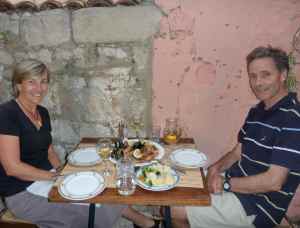
An idyllic day was followed by dinner at a taverna on Mongonissi, Paxos Island.

DSC00451
Spent a few days at Port Atheni on Meganisi Island off Lefkada, a great spot with many unspoilt and isolated anchorages and deep, blue, clear water. Great for lazing around, drinking Mojitos and eating well. Good spot for David who found plenty of running paths throughout the island.

P1000556

DSC00429

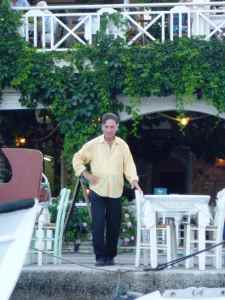
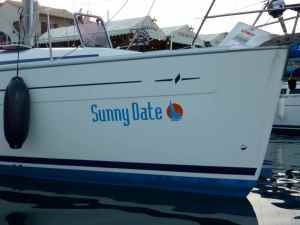
Next move to Sivota Bay, back on Lefkada. We spent an enjoyable few hours watching “Med mooring” where boats drop their anchor in front, and then motor (alarmingly quickly at times) into an almost non –existent space on the town wall. Great potential for crossing anchors, crashing boats, but amazingly it all works! An experience Ian and I are still to try, despite nearly 8 weeks cruising in the Med. Welcomed ashore by Spiros (pic) who tied up our dinghy and invited us for dinner at his restaurant – promising all but the kitchen sink! We obliged and fortunately it was delightful. We moored our dinghy next to one of the Dutch flotilla boats with an original name – who says the Dutch don’t have a sense of humour?

P1000576_2


P1000575

P1000577

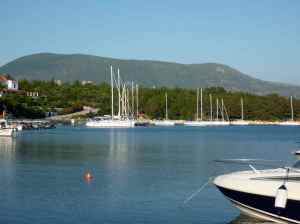
Our last few nights with Jen and David were to be spent on Kefalonia, first stop Fiskardo, a beautiful town, the only town in the Ionian Islands which hadn’t been destroyed in the 1973 earthquake. We anchored with a line ashore amongst the yachts, across the bay from the town wall (full by the time we arrived late afternoon). Swam then went ashore for drinks, dinner and crowd watching in this very beautiful town.

P1000604

P1000586

All went to bed thinking how lovely and peaceful life was, with plans of renting a car the following day to look at inland Kefalonia (made famous by the movie Captain Corelli’s Mandolin). The wind came up during the night and around 4am Ian (who had been up numerous times worrying) woke us all to say that although we were still firmly in place, the boat beside us had dragged and was on the rocks. A rather stressful hour or 2 followed. As we tried to move further out into the bay, our anchor windlass failed. Here we were, drifting back onto a rather fancy very large yacht behind us. Luckily David was able to pull up the anchor – thank goodness they were on board! Once the other yacht had been safely pulled off the rocks, we sailed south to Sami, a very sheltered harbour where we managed to get a spot on the town wall where fortunately we had no need for the anchor. We later heard that about 7 of the probably 15 boats around us had dragged during the night.

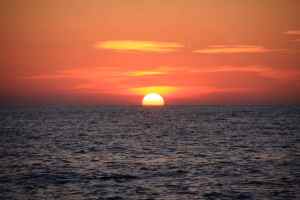
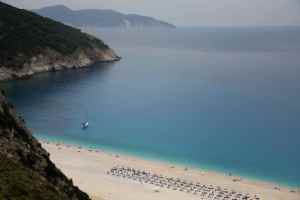
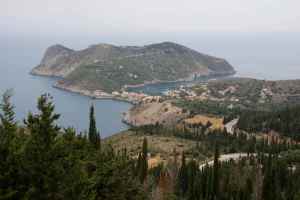
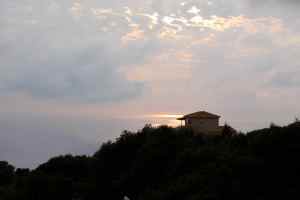
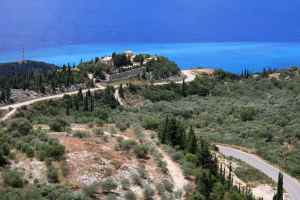
We farewelled Jenny and David and then spent a few days driving around Kefalonia while the windlass was being looked at. It is a beautiful island we spent a few days although the weather was not great, the sea at Myrtos Beach on the west coast was as blue as we’d been told. Port Assos was also a delight, not the best anchorage, but lovely to experience by car. Finished the day with the mandatory ‘Ionian sunset dinner’ watching the sun disappear into the sea (well almost, there was a house in the way!).

IMG_1618

IMG_1642

IMG_1668
Ian and Andreas (local motor cycle mechanic and former ferry boat engineer) pulled the windlass control box apart and after cleaning the horrible looking points, determined that the windlass motor was the culprit after all. This necessitated us backtracking 30 miles to Lefkas Marina to have our anchor windlass repaired. Arrived in a raging thunderstorm and pouring rain, (we were wondering if this was really Greece after 3 days of unsettled weather).

IMG_1514
Took the opportunity of being stuck in an expensive marina to leave Xela while we rented a car and toured Lefkada. Like Kefalonia, Lefkada island is mountainous, with a spectacular western shoreline of beautiful white sandy beaches with incredible blue water. The roads of the Ionian islands are a real challenge narrow, winding, and dotted with either goats (Kefalonia) or rocks (Lefkada).

IMG_1715

IMG_1722

IMG_1725

Anchor windless repaired, we sailed (south again) off into the sunset for Spartachori on Messalonghi Island, for a very pleasant last night in the Ionian before heading for the mainland and Gulf of Corinth. It was so lovely, we decided to stay another night, only to be told by the restaurant owner that there would be no room on the dock – a sign of the busy season to come.

IMG_1737

IMG_1744

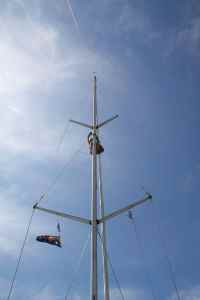
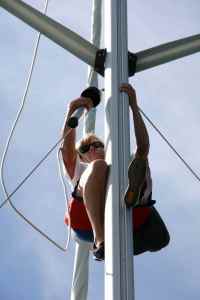
Sailed to Petala on the mainland – very close to the Gulf of Patras, a lovely large but uncrowded bay with scenery pretty much like Aus! Spent 2 days anchored in the bay, doing maintenance, relaxing and reading. Ian learned that if something dangerous needs to be done on the boat, the first mate has to do it (refer photo Cathy up the mast repairing radar reflector!)

IMG_1759


IMG_1766

deck

The Ionian Islands were  a lovely surprise; not at all like the rugged barren islands of the Aegean. Instead they were spectacular mountainous, green and heavily forested.

8E8W1920

Next phase, off to the Gulfs of Patras and Corinth and on to Athens to meet up with Andrew.

Blog 2: Balkans chapter (2nd May-2nd June 2009)

Blog upload #2: The Balkan Chapter (2/5 – 2/6/09)

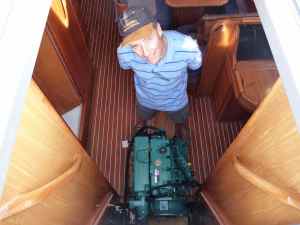
Engine troubles finally sorted out (following removal and road transportation to Zadar for testing in case the parts didn’t solve the problem). It’s nice to have engine back in its rightful place and not in the saloon.

1_1

1_2

1_3

Off sailing once more – both Cooks coping with multi-tasking and each other. The team working well and (so far) relationship intact with no yelling.

Learning rapidly that the Med weather can be quite unpredictable. The only predictable thing about it is that one either has too much or too little wind. (Note the katabatic wind of 35 kts+ that comes off-shore in flat water; without warning).

2_1


Katabatic wind (too much!)

Katabatic wind (too much!)

Life aboard Xela – surprisingly comfortable and spacious although it will be interesting to see how we’re thinking about the space issue in 5 months. There are relatively few places for middle-aged brains to misplace items (eg reading glasses) in a 42 ft boat! Backdrops in the evening are generally not too dusty and the fresh market fish and local wine goes down a treat.

3_2

3_1

3_3

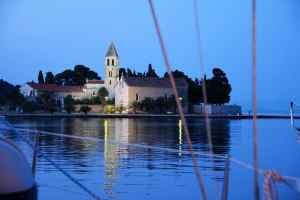
The cultural and scenic sights of Croatia are pleasingly lacking in crowds at this time of the year. The town wall of the old town of Trogir (pictured) is rafted 3-4 boats deep in the season. One exception is Hvar harbour where the peak hour “dancing”, shuffling and jostling of boats at 6pm seems to go on throughout the year.

4_1

Trying hard to keep out of marinas, but sometimes the convenience and basic needs (or wind and weather) dictates a night in a marina – often in spectacular places such as Korcula Town (picture) or Dubrovnik (see below).

5_1

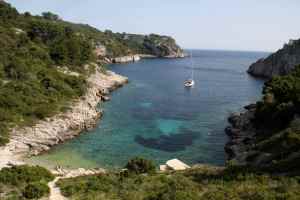
Much of the time we can escape the crowds virtually entirely and at this time of the year it’s possible to find some tranquil and beautiful spots to sit and think (or …sometimes, ….just sit).

6_1


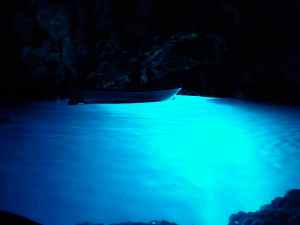
Blue Grotto Bisevo Island

Blue Grotto Bisevo Island

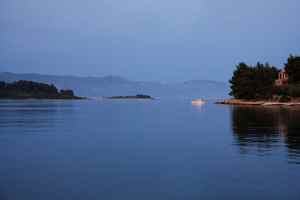
Dusk on Korcula

Dusk on Korcula

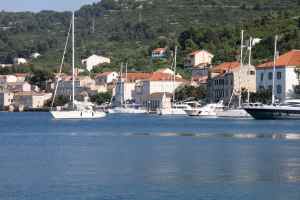
Mooring Med style (stern too) the town wall is a great experience also. Gets you close to the action and the passers-by generally don’t peer into the boat too much. Often close to the markets for quick top up with fresh produce. .

Parking stern-to, Vis harbour

Parking stern-to, Vis harbour

view from Xela, Vis harbour

view from Xela, Vis harbour

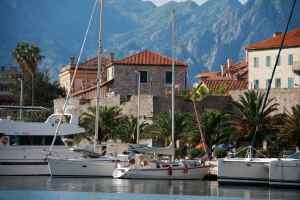
Kotor, Montenegro

Kotor, Montenegro

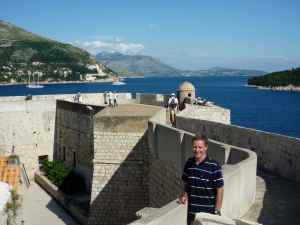
Cathy generally insists on a meal on the town when we can simply step off the boat – have had some excellent food, local wine and the backdrop varies from turquoise waters lapping on the shore of Palmizana Is to the shrapnel pock-marks on the garden wall in Dubrovnik.

Palmizana Is (near Hvar)

Palmizana Is (near Hvar)

Dubrovnik

Dubrovnik

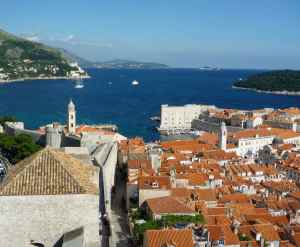
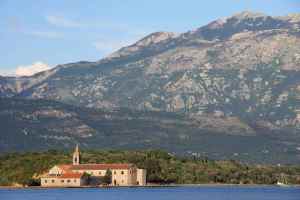
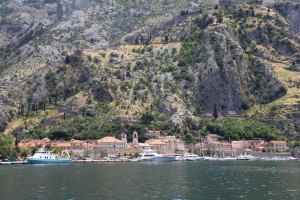
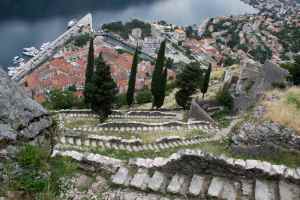
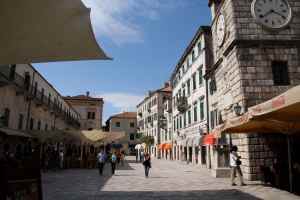
Jewels of the Adriatic?? Dubrovnik has to make the list of course. Montenegro is also superb – spectacular fjord-like black mountains and the walled town of Kotor (look at wall carefully in photo) with its Venetian influence, is a must-see before one dies.

Dubrovnik

Dubrovnik

9_2

Island monastery - Montenegro

Island monastery - Montenegro

Kotor, Montenegro (note the walls)

Kotor, Montenegro (note the walls)

9_5

9_6


Until next time; ….Xray_Echo_Lima_Alpha…Out.

Epilogue:
While all this sounds idyllic (and it is) live aboard life isn’t all “beer and skittles”: For example, some nights one can lie awake listening to strange anchor chain noises wondering whether it’s dragging; or to the 45kt winds whistling through what we thought was a “bullet-proof” anchorage; or tapping the barometer and wondering about the weather while trying to understand the weather report delivered in a heavy Montenegrin accent through radio static. Jumping over the side with mask and snorkel to sort out a prop fouled by a piece of stray fishing net while blowing sideways into a new harbour. Learning, that in a Sea without tides, the water level can change overnight by as much as a metre (driven by wind, barometric pressure changes); that published timetables and schedules don’t really exist – making alternative transport planning difficult; no matter how hard one tries, one cannot eliminate all “bangs and squeaks” in a boat overnight; checking out of Croatia with boat berthed alongside between enormous cruise ships while customs officials tell you that you must remain at least 20 Nm offshore while covering a measly 20 Nm from Dubrovnik to Montenegro; pulling on woollen tights and vests on the first official day of summer thinking that hot weather last week was so long ago. Last but not least, wondering why in the Adriatic in which the prevailing wind should be northerly that we are travelling south and seem to have wind on the nose 90% of the time.

Finally- our first post

Last amended: 14/5/09
Cook sailing trip April 18th- October 18th, 2009

April 18th – 28th: Cairo and cruise “up” the Nile to Luxor, Edfu, and Aswan plus side trip to mind-boggling Abu Simbel. Anything less than 2,500 yrs old now seems “recent”! Coping with the 450C temperatures – have to slow down and go with the flow. Cairo is fascinating but choked with (20M) people and traffic. Camel ride to the Giza pyramids – touristy I know, but a “must do”. Camels are more comfortable than they look!1_Egypt2_Egypt

3_Egypt


April 28th: Zagreb – a very attractive, vibrant, and cosmopolitan city. It seems the centre is full of yuppies drinking cappuccinos – I wonder who’s out working? Croatian food seems to have improved greatly since our last visit in ’03 (or we’ve gone more upmarket than the local “Y” in our old age).


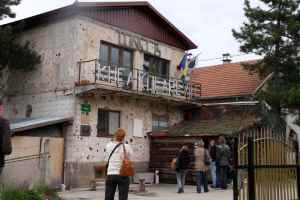
April 29th: Full day’s drive from Zagreb to Sarajevo, through the Bosnian countryside and small poor-ish towns. Aftermath of war still very obvious especially around border areas with many bombed out, abandoned buildings. Confusing to see many names in Cyrillic script, luckily less prevalent as we approached Sarajevo. Wandered through the delightful old town in Sarajevo (strong Turkish influence apparent) – depressing amount of damage still evident from the war. Hearing and reading more of the war made it hard to imagine the horror of 4 years living daily under siege and negotiating “sniper alley” or simply getting drinking water from the river or cutting down the few remaining trees to light a heating/cooking fire (all power, telecommunications and water cut off for 4 yrs by the Serbs).

4_Sarajevo

6_Sarajevo

Thurs 30th April: Fascinating tour of the” Tunnel” which had been constructed under the airport runway to connect the city with the thin strip of Bosnian held (free) territory outside beyond the Serbian held territory. This was the only link with the outside world during the 4yr siege of Sarajevo (‘93 – ’95).

7_Sarajevo

Fri May 1st: Ian’s 55th!! Drove though some spectacular Bosnian countryside, beautiful mountains, lakes and on to Mostar. Separated from a few excess Kuna by a gypsy – guided tour of the old city. Was awfully crowded but the reconstructed ancient bridge (totally and senselessly destroyed by the Serbs during the war) now rebuilt. Arrived at Marina Kremik (back in Croatia – near Primosten) late afternoon, for our first view of Xela (Bavaria 42 Cruiser) – our home for the next 5 mths! Absolutely spotless in true German fashion – spacious and comfortable. Checked into the nearby Hotel Zora in the lovely old town of Primosten for Ian’s birthday. Zora didn’t live up to the brochures – Disney meets Oktoberfest! Full of packaged German family tours, loud music bad taste. Ian’s birthday dinner was a “pig trough” affair (worse than the hospital cafeteria) and very ordinary wine – saved by the birthday cake and candles organised by the barman.9_Primosten-Bday

May 2nd – 3rd: Provisioned the boat with what looks like enough food for a family of 6 for a year; return rental car and prepared boat for departure. A lot of stuff still needs to be sourced for 5mth cruise – plan to return after 1 week shakedown cruise to the Kornati Islands (30 miles off the coast).

10_Marina_Kremik

May 4th – May 11th: We’re off – Great to be finally sailing! A little cool still – only shed the long johns yesterday and definitely too cool to swim just yet. Brisk sail north, with fair winds (15-19kts). Xela performing surprisingly well with a “standard” rig which is very easy to manage. Spectacular Krka waterfalls (up the inland waterway from Sibenik) and a small motor boat to the beautiful Visovic monastery on a small, very isolated island above the falls.

11_Xela_Kornati

Thursday 7th May: Left mooring in Skradin early for the Kornati Islands. Lovely passage past Sibenik which looked beautiful in the early morning light, made us sorry that we hadn’t visited – maybe in September. Great sail up to the Kornati islands (national park), many other yachts about, nice breeze.

13_Kornati

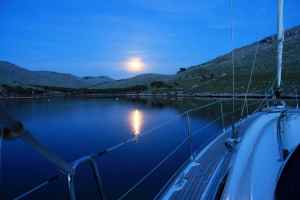
Fri 8th – Sun 10th: Pottering around Kornat Is and Dugi Otok (Telasica Bay*). Highlights included: peace and solitude; sleeping in; smell of pine trees 20 miles off shore; crystal clear turquoise water; finches twittering in the scrub; simultaneous sunset & full moonrise reflected on the water at either end of the boat; walks up to the peaks; the bright blue “Salt lake”; two superb fish feeds at local restaurants; no loud naked Germans (well only a couple). We’ll need to make the most of the isolation and being the only boat anchored in the bay – the Adriatic will be chock-a-block when the ‘season’ warms up. [*parked here with the kids in 2003]. Lowpoints: Decision to do the 7 day shake down cruise before returning via Marina Kremik vindicated as numerous deficiencies discovered: leaking ‘O’ ring on engine cut-off valve; steering post Teflon packing too tight giving very stiff steering and ++ battery drainage on autopilot – boat needs to be lifted out of water to drop rudder out to fix; noisy transmission – needs attention and parts; the absent barometer replaced with non-functioning barometer; no bungs for hull penetrations; still no C-Map card for Aegean; no anchor chain snubber; need extra springer line to slip when bow-to walls; insufficient propane bottles; no dinghy seat; etc, etc….. Navigational deficiencies: no deviation card in a boat in which the compass deviation exceeds magnetic variation; port binnacle compass 80 error rectified by shifting spare anchor stowed adjacent; Tridata out of calibration with GPS and binnacle compass (needs recalibration); log reading 2 kts slow – needs recalibration; Croatian charts do not use the WGS84 datum (in error -3’ longitude).

14_Kornati

15_Kornati

16_Kornati_Sunset17_Kornati_Moonrise

18_TelasicaBay


Mon 11th: Returned to Marina Kremik (beautiful sail –approx 40Nm) for repairs – boat lifted out of water for 2hrs to fix rudder bearing/Teflon packing.

Tues 12th: Day in Split sourcing paper charts – everyone looks at me as if I’m a cave man for contemplating using paper charts! Call me anal, but I’m not going to sea with only GPS! I suspect most young blokes in chandlers haven’t even seen a paper chart! Cannot find a course plotter either – wishing I’d not stupidly left both of mine in Sydney.

Wed 13th: A new low point today – Leo fixed repaired the transmission, but the damage probably also damaged a major engine bearing. We gave up idea of leaving today and had a great day doing the tourist thing in Trogir – a truly lovely town with a 1246 Romanesque cathedral, great carvings in limestone going back to 13th Century. View from belfry worth the vertiginous climb. Only 2 yachts alongside the promenade – they will be nose to tail and 3 deep in the season – can’t wait! Returned to boat at 4pm. The downside is that the whole engine has to come out and go to Volvo in Zadar to fix the bearing +/- whole gear box! Glad we can do this now rather than in Turkey; the downside is that time is slipping away. The high point of the day was Zoran (Mare Charter) – arranged a cruising “blister” for the season and the appropriate rigging. Even better – he asked do we need charts? Is the Pope a catholic we said!!!!! We can’t buy them for love or money, but he loaned us 30 charts to cover the entire trip to Montenegro, Brindisi, Corinth Canal, all the Greek islands and Turkey (+ Crete if we’re so inclined) – truly a magnificent gesture in a land where charts can NOT be sourced – it truly made my day – I can now sleep at night!